
You are currently browsing the tag archive for the ‘markets’ tag.
There was a time when daily prices for US Treasuries were hand-written on two or three sheets of paper from a yellow legal-pad and run by messenger to the Associated Press and Dow Jones. The AP needed the prices early enough to send to their members and Dow Jones was under pressure to make the deadline for the Wall Street Journal and their newswire. The messenger couldn’t wait for the closing prices. They had deadlines. No. A clerk would scribble the list furiously and send it off – smudges and all.
Bloomberg called it the modern day pony express. It wasn’t far off. Some poor runner would bolt into the respective newsrooms, hand over a precious few sheets of paper, and watch the operator enter the prices into their system. But in 1987, Bloomberg would change that.
Bloomberg’s terminals had found a quiet niche in the aggregation and analysis of Treasury pricing data. It had so much data that it had beat the Fed. Bloomberg had better, more up to date data than the Federal Reserve. It’s prices were more reliable than the Federal Reserve. What followed was perhaps one of the finest coups of earned media in history.
Rather than rely on legal pads and couriers, why not wires? Why not a Bloomberg terminal? The AP and Dow Jones each took at terminal. They got better data. They got closing prices. And each day, they ran a full page of Treasury prices, courtesy of the terminal and credited to Bloomberg.
Lesson learned: if you want media, earn it.
From our first day in business, Bloomberg was making news, with numbers
—Mike Bloomberg and a modest ambition
While most news organizations today are listing in the high seas of the digital world, Bloomberg News has proven to be an adventurous and successful competitor. They started with a key asset, the Bloomberg terminal, and a gaping niche – business journalism. As it has grown, it’s become an instrument of recognition for the entire Bloomberg enterprise, a sales tool, and a critical hedge against competition.
Bloomberg seems to have demonstrated that it’s possible to make money from reporting the news. It’s a fierce competitor to the Wall Street Journal, Reuters and other business reporting. It runs a thriving business. But Bloomberg isn’t interested in selling news feeds. Indeed, much of it is given away for free on the web portal. Bloomberg gives it away because it wants to eliminate the profit margin in delivering the news, so it can starve competitors and enhance the value of the terminal. It wants to make the news a commodity.
Bloomberg’s entry into journalism would push traditional news sources to improve their coverage and respond to Bloomberg News. The underlying dataset in the Bloomberg platform gave them a distinct informational advantage over the competition. The information and analytics on financial instruments was just not widely available and not something on which traditional news sources had focused. As Bloomberg says, they were already in the news business – just with numbers. The terminal had become, for example, the de facto source of pricing for US Treasuries and replaced the Federal Reserve’s daily pricing sheet with a Bloomberg terminal at the offices of the AP. Each day, when the AP published the closing Treasury prices, sourced and attributed to Bloomberg, they were effectively running a news story, or an advertisement – take your pick. This unique resource separated them from the competition, gave them pricing power and promoted the terminal – all in one stroke.
 Business journalism at the time also lacked the luster of reporting on riots, elections, and wars. Journalism schools didn’t teach business and finance reporting. The mainstream, national press would gloss over financial markets on the way toward bigger stories. As Bloomberg remarks, “Even at the Wall Street Journal, it was rare to find top editors who included among their accomplishments daily stints covering stocks and bonds.” Bloomberg News would enter a seemingly uncontested field. In 1988, Bloomberg marshalled Matt Winkler to enter the fray.
Bloomberg News also provided a much-needed hedge against the possibility of losing key news-suppliers, such as Dow Jones. Bloomberg had already eaten into the Dow Jones Telerate business. While Telerate presented static images of Treasury prices, Bloomberg users were presented with live data on which they could run analytics. When Dow Jones did respond, they pulled the plug on their feeds to Bloomberg, expecting that Bloomberg customers would come back to Telerate and abandon the Bloomberg platform. It turned out that clients found Bloomberg News sufficient: at worst, good enough to get the job done and, at best, invaluable in combination with the underlying dataset. Dow Jones eventually relented six months later and resumed delivering their feeds through the Bloomberg platform. Telerate would later be shut down.
The rapidly growing news enterprise advanced and protected the Bloomberg franchise. It spread the reputation and influence of the Bloomberg organization, and this sold more Bloombergs. More Bloombergs funded more news, and Bloomberg news became increasingly visible beyond the terminal. It worked its way into radio and television first. Then it began traditional print syndication, and syndication brought Bloomberg’s business reporting to the New York Times, among others. With these outlets, the Bloomberg brand became more prominent, more potent. It sold more Bloombergs.
 The news division at Bloomberg was never designed to sell the news. It was designed to sell Bloombergs. It started with a market niche and a key asset – business reporting and the terminal. But it rapidly evolved into an important hedge against the risk of key suppliers, such as Dow Jones, cutting off Bloomberg as a customer. When Dow Jones dared to do so, Bloomberg had won. Bloomberg news was good enough to be a substitute or an improvement on most serious business and financial reporting from Reuters, the Wall Street Journal, the FT, the New York Times, and anyone else who might have contact with their customers. Business and financial news reporting, at first an area of distinction for Bloomberg, had become a commodity.
Because Bloomberg doesn’t need to sell the news, those that do are at a disadvantage. They rely on profit margins from distribution, sales and subscriptions to the news. Bloomberg doesn’t. Bloomberg makes money through subscriptions, but they’re subscriptions to the terminal. The news is just another commodity, and it suits Bloomberg just fine to see it have commodity-margins. It just makes the terminal more valuable.
BlackRock caused a stir in 2009 when it announced its intention to increase the practice of crossing trades. It signaled to the street that they were sufficiently large to find counterparties within and among their many portfolios and clients. They would no longer rely so greatly on the efforts of outside brokers. Brokerages recoiled in defense and BlackRock was forced to say that it would continue to be a big customer of the street. Nonetheless, their intention hung in the air.
It wasn’t that crossing trades would comprise a new development. Asset managers have crossed trades before and in great number for years. Why should an investment manager go to a brokerage to sell a security when another of the firm’s portfolios or clients would like to buy it? Cross the trade, and you don’t have to pay a brokerage fee. The practice lowers costs and lowers risks by limiting one’s reliance on the street for pricing, market intelligence, and execution. BlackRock’s scale, however, suggested that something might be different this time. But was it?
BlackRock’s proposal represents the slow realization of a long-standing trend in the securities market – the systematic and persistent diffusion of the market center. In practice, it has meant a progressive shift from transactions through a fully regulated cartel at the core to a spontaneous and dynamic arrangement of counterparties. In fact, BlackRock’s proposal today bears the same signature as the odd-lot controversy in 1975, when Merrill Lynch proposed executing odd-lot trades on behalf of their clients. But it differs in one important respect. Rather than a brokerage house, it’s the investment manager that is driving the change: a principal, rather than an agent.
Merrill Lynch approached the New York Stock Exchange in 1975 with a simple proposal. They wanted to execute odd-lot trades off the exchange. Odd-lot trades comprised orders of fewer than 100 shares. Brokers would typically pass these to floor specialists, who would bundle them in round lots and execute them on behalf of a Merrill Lynch client. Merrill proposed to match odd-lot trades with buyers from among their existing clients and execute them at a lower cost than otherwise. The specialists were terrified.
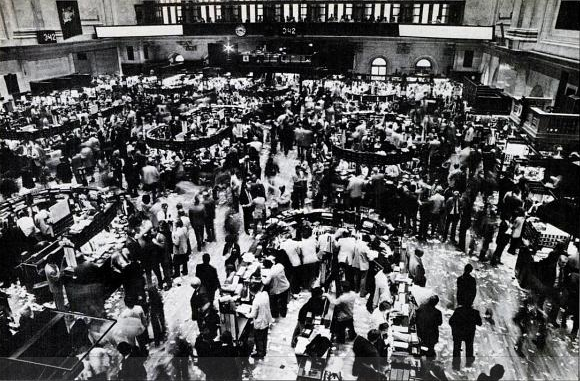
Merrill’s proposal would shift transactions away from the specialized floor traders, such as Carlisle DeCoppet, for example, the reigning specialist in odd-lot trades. Odd-lot trading comprised less than 5% of trading on the exchange, but the members feared the change would undermine a carefully constructed cartel that, through policy and procedure, directed the vast majority of trades to the floor of the exchange for execution by member firms. Chris Welles, writing in New York Magazine, 20 October, 1975, laid out the stakes: “Carlisle DeCoppet’s monopoly would be destroyed and its profits all but wiped out if Merrill Lynch goes ahead with its plan, for Merrill’s 1.5 million customers account for 26 percent of Carlisle’s business.” Merrill Lynch would effectively create a mini-stock exchange, separate from the NYSE.
The NYSE had only just been compelled by the SEC to no longer fix brokerage rates in May. The exchange forfeited the 183 year practice on May 1st, 1975, a day that would come to be known as May Day. Members, having lost the organizing influence of the cartel’s discipline, quickly found themselves in a price war, undercutting each other dramatically. With it emerged the first generation of discount brokerages. Many rules, however, remained, but the exchange was losing power.
The debate had moved to Rule 394, which had been designed to limit off-floor execution of trades. Though it did permit them if the off-floor price was better than the floor price, the spirit of the rule was intended to keep as much execution on the floor as possible: “Even if Merrill Lynch isn’t formally breaking 394, they are opening up a wedge. They are violating the spirit of 394,” said Harry Jacobson, a specialist on the floor at the time and then head of the Association for the Preservation of the Auction Market, a 700-member strong association of specialists with an interest in floor trading. Donald Weeden likened it to the Blackout Rule for sports-fans, “league-sponsored rules erected to assure a full-house for club owners.” Welles had just published The Last Days of the Club, in which he outlined the decline of the then stalwart Wall Street firms and subsequent rise of their inheritors. The title alone told the story, but the market for exchange seats made it tangible. The price for an exchange seat dropped in one month from $125k to $65k on the news of Merrill’s plan.
Jacobson, the APAM, and the floor was already under pressure. The increased importance of block-trading and simultaneous emergence of new technology had changed the market. Institutional investors had reached a critical mass. With their increased asset base, they increasingly looked to the floor to handle block trades. These weren’t odd-lots or round lots. They were large lots. Individual investors had rarely required such large capacity, but with their assets pooled in large institutions, it became an expected and regular event for which the specialists on the floor were unprepared. If these trades took them by surprise, new technologies, their adoption by institutional investors, and their impact on the world around the floor would have seemed even more earth-shattering to the convivial contretemps so often associated with the floor – grab-assing, practical jokes, and hijinks. Automation had come and gone for the floor specialists, with one noting, despite the prospect of considerable savings for individual investors, “let’s not engineer ourselves out of business.”
Merrill Lynch would get its way. May Day had weakened the exchange. Merrill’s proposal did not violate 394. It saved their customers money, and it uncovered the swollen and unsympathetic features of the cartel that dominated equity trading through the NYSE. The securities market would begin the systematic and persistent diffusion of the market center in favor of the edge. In 1975, the market moved from the floor specialists at the center to the investor-facing brokers, such as Merrill Lynch, at the edge. The floor lost its monopoly and other firms, such as Merrill Lynch, other exchanges, or agents would emerge as competitors.
Almost thirty-five years later, Larry Fink would voice a similar proposal, but it would come from an asset manager, not a broker or an exchange: a principal, not an agent. In September 2009, Fink announced that BlackRock would organize a system to cross trades within its massive asset-base for the benefit of the firm and its clients. He introduced it in terms of “trading friction cost” and lamented, “we need to make sure we’re not being taken advantage of.” Just like Merrill in the odd-lot controversy, BlackRock would cross-trades to benefit their clients: “our clients are going to make more return.” Fink would go on to say, “There’s no question, you have seen huge profitability in some of these institutions. The widest bid-ask spreads are in fixed income — the more opaque the market, the more money the market makers are making.” BlackRock wasn’t just interested in equities, it was interested in fixed income and perhaps other markets as well.
BlackRock would raise the specter of crossing trades again in late 2010. The FT quoted BlackRock president, Rob Kapito, on 28 December 2010: “We are developing the technology in-house to offer better value by lowering trading costs.” BlackRock’s push was quickly compared to the ill-fated E-Crossnet collaboration between Merrill Lynch Investment Managers and Barclays Global Investors in 2000. The collaboration aimed to provide a buy-side only crossing network to circumvent traditional brokers. E-Crossnet was part of the same shift from the center of the marketplace that began in 1975, but it had more in common with existing ECNs of the time. It failed to gain traction and was sold to ITG who combined it with the POSIT dark pool – effectively as an external agent. BlackRock, however, would operate as a principal, crossing trades across its vast collection of portfolios. BlackRock would effectively create a mini stock-exchange, separate from the NYSE and separate from everyone else, entirely, and entirely different than E-Crossnet.
E-Crossnet relied on a network effect across buy-side clients. The resulting pool of liquidity would provide low-cost transactions among the participants, but someone still needed to run it. It needed an agent, so it went to ITG. BlackRock’s network relies only on the ability of BlackRock Solutions to design and develop a crossing system that will sit within BlackRock’ trade processing and order management system. BlackRock will run it, and they have sufficient scale to make the returns on those investments economical. Nonetheless, it would not be surprising to see BlackRock license the system to third parties for others to implement in their order flow and trade processing systems, just as they do with the Aladdin system for risk management. It would not be E-Crossnet Revisited. It would be licensed.
The first call for liquidity in BlackRock’s system won’t be to a broker. It will be to BlackRock. And perhaps the first call for Fidelity or Capital Research or AllianceBernstein won’t be to a broker. It will be to themselves, through a clever piece of software written by BlackRock solutions and part of the overarching trend of the market to decompose its center, drive execution toward the edge: from the select membership of the NYSE cartel to a cluster of brokers and other markets, to dark pools and now to the underlying investors and owners of the securities, each linked by pools of liquidity.
I swear to you in front of God…You put me in jail if you talk. … I’m dead if this leaks. I really am … and my career is over.
—Danielle Chiesi, saying, “I’ll be like Martha fucking Stewart,” taped with a co-conspirator in the exchange of inside information, who pleaded guilty to insider trading yesterday, following the guilty-plea of her employer, Mark Kurland: via NYT
Expert networks and traders of inside information are analytically separate categories, not synonyms. This has been the main failure of the press’ coverage of the insider trading scandal. Expert networks match experts with those in need of their expertise. That’s it. Done properly, they bring transparency and compliance to conversations that are otherwise already happening between outside experts and analysts. Expert networks are not clearinghouses for inside information.
Bloomberg News finally brought basic analysis to the discussion around expert networks, rather than the prevailing tone of crude refutation.
Dealbook provides a useful recap of the facts, essentially collecting many of the extant who and what’s that have been involved, along with a fresh set of juicy complaints.
There are users of expert networks, be they hedge funds or mutual funds, that have been known to put a good bit of pressure on the experts to give them more than what they know is permissible information. And anyone who put that kind of pressure on an expert should be very worried right now.
—Sean O’Malley, partner with White & Case: via Reuters
The information trafficked by the four ‘consultants’ went way beyond permissible market research. It was insider information.
—Janice Fedarcyk, a Federal Bureau of Investigation assistant director in charge of the investigation: via WSJ
Few hedge fund managers have the investment skill to deliver the benefits that they promise. They have to find an edge however they can — in this case through the expert networks.
—James Fanto, a professor at Brooklyn Law School in New York, mistaking expert networks for the ethical failings of those alleged to have traded in inside information: via Bloomberg
While the Nobel Prize for Economics is a significant recognition, the Royal Swedish Academy of Sciences does not determine who is qualified to serve on the Board of Governors of the Federal Reserve System.
—Richard Shelby, (R-AL)
The Nobel Prize for economics was recently announced. It went to three economists who provided the theoretical foundation for understanding search markets. Each had found themselves fascinated by the difficulty that buyers and suppliers sometimes have in finding one another. Together, they found that search markets belie commonly held beliefs of classical economics. They have search costs. They’re often inefficient. They provide multiple outcomes. They’re messy.
Messy markets dumbfound classical economics. Markets are supposed to provide unique and efficient outcomes. Search markets don’t, but they don’t resist analysis. The recipients, Peter Diamond, Dale Mortenson, and Christopher Pissarides, demonstrated this with the DMP model for unemployment. But the model also demonstrates the importance of regulation and policy to affect market structure and improve outcomes. This is far from a laissez-faire point of view so commonly held. Though the recipients focused their efforts on the labor markets, the common features they identified in search markets provide a metaphor for understanding other conventional economic markets and, perhaps, non-traditional markets: the process of finding a spouse or even the marketplace for ideas – a concept still reeling from the controversial Supreme Court opinion on Citizens United v FEC.
Diamond, Mortenson and Pissarides, articulated a handful of common traits associated with search markets. Search markets are typically associated with non-exchange-based transactions, such as labor markets. Unlike on an exchange, it’s typically difficult to find the right buyers or sellers, so search and matching costs, for example, are associated with high real costs. Movement in the labor market, for example, requires individuals to quit or be fired, search for a job and be evaluated, and question accepting a position on the basis of the difficulty of and compensation for the work.
Search markets are also inefficient and may include several outcomes. Though only one outcome can be the best, these markets do not yield unique and efficient outcomes associated with classical economics. Instead, they can lead to imbalances, such as resource utilization, which can skew either too high or too low.
The activity within a search market also affects the search market. When a job-seeker, for example, increases their search activity, the overall market becomes more challenging for other job-seekers and easier for recruiting firms. These are called external effects and are not taken into consideration among market participants. It yielded a relationship between job creation and the intensity of workers seeking jobs. If workers increase the intensity with which they look for jobs, the marginal improvement in a company’s ability to fill a position will encourage employers to open searches for more jobs. It also explains why job openings have increased recently, but the unemployment rate has not changed substantially. These may be attributed to structural issues within the labor market, such as uncertainty about regulation and taxes, a reduced ability to sell one’s house and move to where the jobs are, among other reasons. Perhaps we might also see option-taking by employers. For example, many people are looking for work with intensity, firms can easily fill positions. With low search costs, posting additional vacancies allows them an inexpensive option to hire, should they find someone.
Diamond, Mortenson, and Pissarides, initially working independently, soon found one another in perhaps an example of their own theory of search markets. The realization of one another’s interests galvanized their efforts, and they organized the Diamond-Mortenson-Pissarides (DMP) model to explain the Beveridge Curve. The Beveridge Curve denotes an empirical pattern of high unemployment and low vacancies or low unemployment and high vacancies. The DMP model broke new ground by providing an explanation for the relationship between the underlying economy, various regulations, and the position on the curve.
Rigidities in the labor market can contribute to unemployment. Participants seek to optimize both compensation and the quality of the work required. One’s inclination to compromise before finding the optimal combination might be determined by jobless benefits, the performance of one’s portfolio, or the condition of the overall economy. Similarly, employers might delay listing vacancies or hiring in general if they find it more difficult to fire employees when they feel necessary. India, for example, maintains a rule pertaining to industrial establishments of 100 workers or more. Rather than require the customary one-month notice on termination, industrial establishments require a three month written notice to employees and prior authorization from the appropriate government authority.
The DMP model, however, does not deny the benefits of regulation. Indeed, some regulations may introduce rigidities that impede the market, but properly applied, they may improve the functioning of the market. Though higher unemployment benefits predictably lead to higher unemployment and a higher search time for the unemployed, the DMP model suggests that it nonetheless has its place. Some job searches are complicated by the rarity of an individual’s skills. Without unemployment benefits, they might not have the time to conduct a thorough search. Circumstances will require that they take a position that does not capitalize on their abilities, and the mismatch between an individual and their job will result in a net loss in welfare for the economy overall. If a skilled machinist has to stock shelves at Walmart, the economy does not benefit from the investment required to cultivate those skills in the first place and may pay a price in a company’s inability to fill a vacancy. Without a proper match, the economy will function below its capacity.
Though the recipients’ work centered on the labor markets, search markets have also been applied to many areas where buyers and sellers find it difficult or expensive to find one another. Among them, the process of finding a suitable spouse, identifying and negotiating with strategic suppliers, used car shopping, and perhaps expert networks. Some of these have been explored, others may benefit from analysis through the lens of a search market. Expert networks, a relatively new phenomenon, connect those in need of expertise with those who have expertise through a costly and fitful process of collecting, profiling and delivering independent consultants, former executives, former government officials, and others for paid phone consultations and other engagements.
The metaphor of the market has even been used to understand the freedom of speech guaranteed by the Constitution. Viewing the marketplace of ideas as a search market might be just the metaphor Stevens was looking for when he dissented to the Supreme Court’s decision in Citizens United vs. FEC earlier this year. Indeed, it’s an elaboration of Professor George Stigler’s precursor to search markets discussed the search costs associated with information in his 1961 paper, The Economics of Information. Perhaps it was what Stevens had been struggling with when he wrote:
All of the majority’s theoretical arguments turn on a proposition with undeniable surface appeal but little grounding in evidence or experience, “that there is no such thing as too much speech,”
The marketplace of ideas is a search market. It’s messy. It yields multiple and inefficient outcomes. The Nobel Committee’s reward of Diamond, Mortenson, and Pissarides’ work on Monday helped us understand that better and laid bare the insufficiency of the laissez-faire perspective so often taken.
 Stilltitled